
Angelo Donghia Foundation grant brings FeltLOOM to UK SoftLab
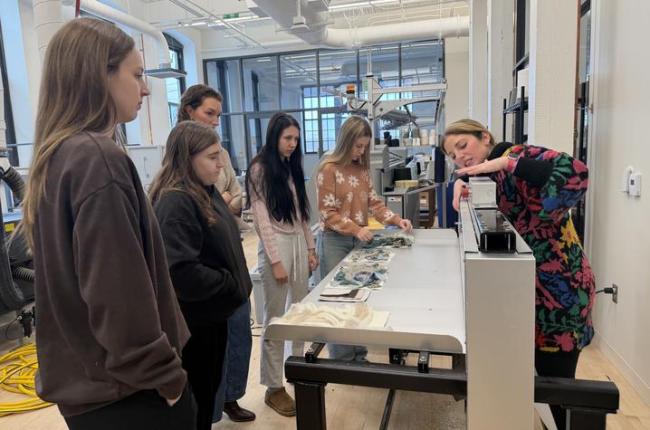
The University of Kentucky School of Interiors has been awarded a $50,000 grant from the Angelo Donghia Foundation to purchase a FeltLOOM, a multineedle industrial felting machine with a user-friendly design and intuitive operation, enhancing the SoftLab’s capacity to support a wider range of students and design education initiatives.
Established in 2001 in honor of the late American designer Angelo R. Donghia, the foundation supports interior design education through student scholarships and programmatic grants.
The grant proposal, to provide softgoods equipment that has a low barrier to entry, making it more accessible to students and design education broadly, was developed by Helen Turner, School of Interiors director and associate professor; Lindsey Fay, associate dean for research; and Rebekah Radtke, associate professor.
“Until now, students have had access to the tufting guns and a digital knitting machine in the SoftLab, which are relatively easy to use. However, the FeltLOOM is even more accessible,” Turner said. “A first-year design student or even a student outside of the design discipline could probably do a 30-minute workshop and be able to operate it fully by themselves. It’s a great entry point into soft making.”
That same simplicity that benefits students today is what drove the machine’s original development. Drawing on their experience raising alpacas, llamas and sheep, Kentucky-based founders Don Bowles and Lanette Freitag designed the FeltLOOM as a small-scale, industrially capable machine to streamline what had traditionally been a slow, labor-intensive wool-processing workflow.
More than 23 years after its first iteration, and with support from the UK Center for Manufacturing, Kentucky Agricultural Development Board, Kentucky Science and Technology Corporation, and Innovation and Commercialization Center, the now patented technology is used in 31 countries across applications ranging from aerospace engineering to fashion.
“This isn’t just a piece of equipment, it’s a teaching tool,” Turner said. “Being able to integrate a Kentucky-made machine into our curriculum, with access to the inventor so close by, gives students a uniquely hands-on understanding of how innovation, design and entrepreneurship intersect.”
Freitag was there the day School of Interiors faculty installed the FeltLOOM in the SoftLab, becoming what she hopes is the first of many visits to the space.
“UK played such a pivotal role in helping us get FeltLOOM out into the world, and it is almost a full circle moment to see our machine on campus,” Freitag said. “I am excited to see what kind of work these students and researchers will create.”
With current uses in everything from construction to design, the FeltLOOM’s impact extends far beyond a single discipline.
“Because the SoftLab is shared across the College of Design, students and faculty from architecture, product design and even other programs beyond design will be able to use the machine to explore soft-goods fabrication at multiple scales from products and wearables to furnishings and full-scale installations,” Turner said. “This kind of shared access reflects contemporary design practice and creates new opportunities for collaboration, material research and experimentation across the building and beyond.”
In fact, Radtke is currently mentoring an engineering student exploring the FeltLOOM’s potential for processing hemp into textiles for a range of applications. Although the project is still in its early stages, Radtke says it already signals what’s possible for the SoftLab as a hub for cross-disciplinary research.
“This project is just one example of the truly multidisciplinary nature of materials research,” Radtke said. “Materials science is a university-wide research priority, and the opportunity to collaborate across design, engineering and agriculture, then using a Kentucky-made machine to develop what could become the next generation of sustainable materials is something to look forward to.”
Although projects like this highlight the multidisciplinary nature of ongoing materials research, Fay said the FeltLOOM also signals the continuation of broader, university-wide collaboration.
“The FeltLOOM strengthens our ability to engage in materials research conversations happening across the university,” Fay said. “It positions design not only as a creative discipline, but as an active research partner shaping how new materials are developed and used.”
This story originally ran in UKNow here.