
Architecture students reimagine a Lexington warehouse through AI-informed design
What does it mean to design with artificial intelligence without surrendering authorship, intuition or humanity?
That question anchored a recent architecture studio led by Jesse Voigt, instructor in the University of Kentucky College of Design. The course examined how emerging technologies are reshaping architectural practice, while reinforcing the fundamental roles of narrative, research and human judgment in design.
In this joint undergraduate and graduate studio, students were asked to reimagine a vacant warehouse at 1801 Edison Drive as a future cultural hub for Lexington. Rather than using AI as a shortcut or image generator, the studio positioned it as a conceptual “client,” prompting students to interrogate its assumptions, navigate its limitations and ultimately define their own roles as designers.
The project required two deliverables: a macro-level proposal for a cultural center on the Edison Drive site and a micro-level design of an element that would hypothetically live within that space. Projects had to account for the existing structure, basic building code requirements and the surrounding residential context, all while being grounded in a clearly articulated narrative.
“Without a narrative, designers miss the fundamental questions: Why do we do what we do? Where do we do it? And for whom? These questions will become even more prevalent as our industry shifts toward prompting AI to quickly conceptualize design spaces,” Voigt said.
That tension between machine logic and human intuition played out most clearly in the work of architecture students Emilie Rice and Emily Hernandez-Pachon, whose individual projects and shared fabrication component explored culture, craft and technology through both digital and deeply physical means.
Reading the site, rewriting its future
For Rice, who graduated in December 2025, the history of the Edison Drive site became the foundation of her design narrative. The warehouse was originally built in 1947 as the General Electric Lamp factory, a major employer that helped shape surrounding neighborhoods during Lexington’s mid-century growth. In response to the site’s past and future potential, Rice proposed transforming the building into a light-focused exploratory center centered on science and technology.
Rather than functioning as a critical collaborator, Rice initially found that the AI client proved agreeable and imprecise, often affirming her design decisions without meaningful critique. In response, Rice shifted her strategy. Instead of asking AI to design, she repurposed it as a research and technical tool, using it to interpret archival construction photographs, identify structural systems and assist with dimensional calculations. The machine became less an author and more an instrument, clarifying where human judgment was indispensable.
“With the invention of LED lighting, the factories' most famous PAR headlamps became obsolete, eventually leading to its closure,” Rice said. “The history does not only represent the cities' development but draws a parallel to present day architectural practice, as AI challenges the traditional architectural industry and the role of architects and designers.”
Culture, craft and community
Hernandez-Pachon, an architecture senior, approached the same site through culture and community rather than history alone. She proposed a fiber and textile cultural center designed as a public workspace intended to be part gathering place, part making environment that extended the collaborative culture of campus into the surrounding neighborhoods.
Initially, Hernandez-Pachon kept the AI client at arm’s length, concerned about preserving creative autonomy. Despite extensive, original iterations early on, Hernandez-Pachon felt her final form for the cultural center was unresolved, and no amount of refinement produced a direction that fully resonated with her vision of a public workspace inspired by the history and culture of the area.
That impasse shifted when the AI client introduced the idea of the Kentucky state quilt pattern. The reference provided a culturally grounded and tangible framework that she could abstract and manipulate, ultimately informing the final form of the cultural center.
“I would not have created that model, or arrived at that form, without the spark that AI provided,” Hernandez-Pachon said. “While I guided the final direction, I recognized that AI was the catalyst that shifted my project to physical exploration.”
A shared installation and metaphor
For the studio’s fabrication component, Rice partnered with Hernandez-Pachon to create a suspended installation inspired by the Jacquard loom, an early weaving machine often considered a precursor to modern computing. The loom used punched cards to encode patterns, introducing the idea that instructions could be programmed into material.
Rather than replicating the cards exactly, the students created their own large-scale interpretation using pegboard. They stitched words and phrases into the surface, translating language into binary code, a system of ones and zeros that underpins digital computing today. Each stitched mark was placed by hand with the installation ultimately resembling a Jacquard punch card moving through a loom.
AI was used sparingly and intentionally: first to translate language into binary, and later to help calculate the structural bracing needed to safely suspend the piece. Everything else, stitching, assembly and final composition, was carried out manually.
“While AI generated the organizational logic, the physical act of stitching and assembling the piece left traces of our own labor and decision making,” Hernandez-Pachon said.
The final piece used textiles as a metaphor for how designers can engage AI as a tool that sets structure, while humans retain authorship through making and intuition.
Lessons beyond the studio
For both students, the studio became less about mastering a new technology and more about learning discernment: when to trust tools, when to resist them and when to lean into intuition.
“Getting to know the 'enemy', and how to use it effectively is a skill that will inevitably be a part of my professional future,” Rice said.
For Voigt, that shift in mindset was exactly the point of the studio.
“Ultimately, the discovery was that AI is best used as a bridge — one that expands a designer’s knowledge, research capacity and technological skill set,” she said. “In every instance, AI clearly demonstrated limitations that required human intervention; it did not replace the student’s fundamental role as researcher and designer of their own project.”
The final review underscored the studio’s real-world relevance. Jurors included professionals and city leaders, among them city council members whose districts include the Edison Drive site, individuals who may one day influence decisions about its future.
“It was great seeing the different possibilities and the imaginations of the students; none [of the projects] were alike and the students seem to really enjoy the exercise,” said Dave Sevigny, council member for Lexington’s District 10, which houses the project site. “I think it would be interesting to bring in a few local developers who do bigger projects and have them provide the parameters because they know what they need and what they can build or reach out to the current property owner and do the project that way. That property will get redeveloped eventually.”
For students, the takeaway was clear: designing with AI is not about surrendering authorship but sharpening it. In a profession in transition, the studio reinforced that technology may evolve but human judgment remains essential.
In the end, every project shared one truth: all the work presented in studio was created by a human, even if a machine helped refine the idea.
This story originally ran in UKNow here.
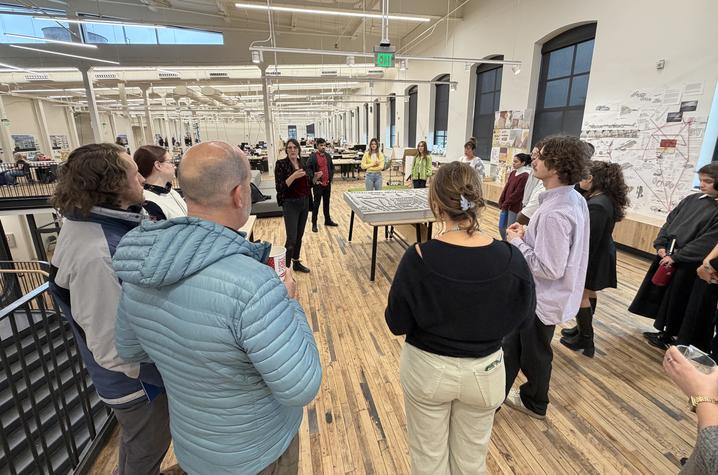
Instructor Jesse Voigt gives jurors an introduction to her studio's Ai-incorporated project prior to final critiques.
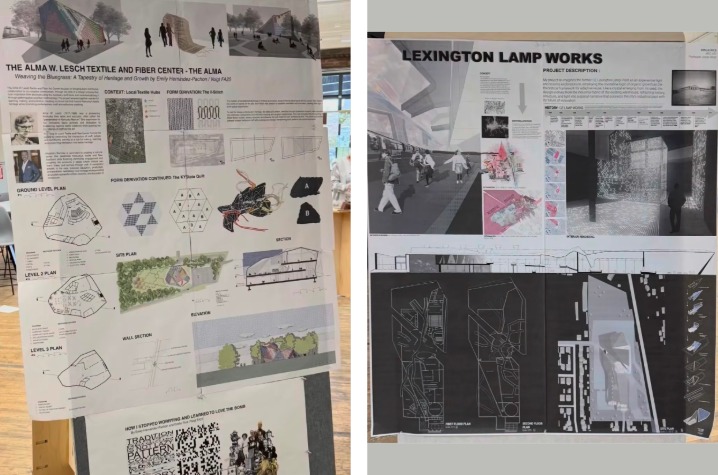
Emily Hernandez-Pachon's (left) and Emilie Rice's (right) project pinup for final critiques. Photos provided by Jesse Voigt.
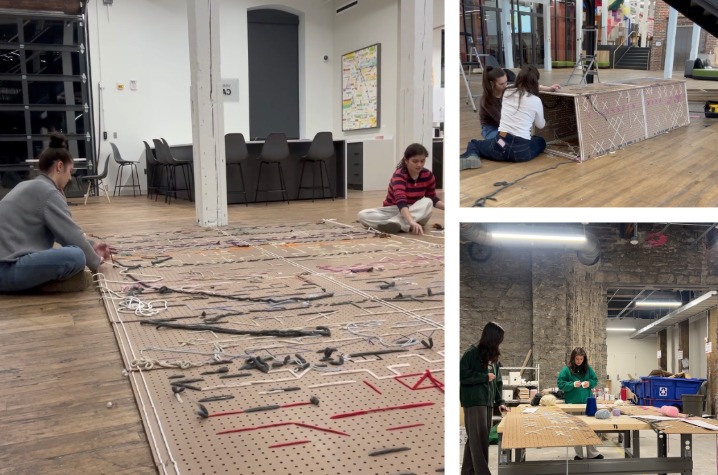
Rice and Hernandez-Pachon manually composed, stitched and assembled their final fabricated piece. Photos provided by Emilie Rice.
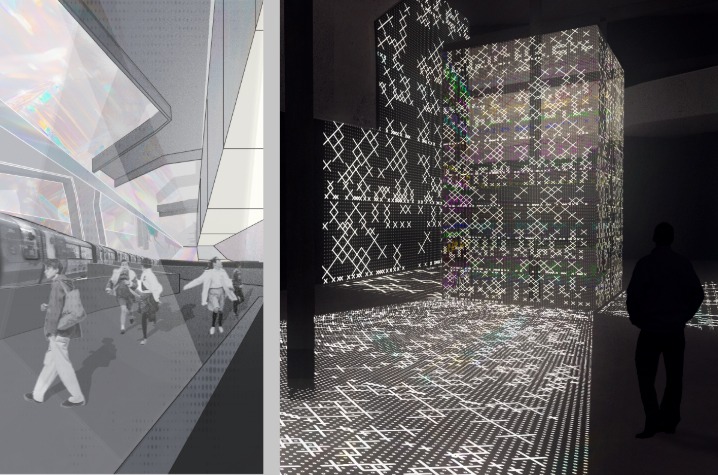
Rice created renderings of how she had reimagined the warehouse: one of her purposed refraction train station (left) and another of the interior space (right). Photos provided by Emilie Rice.

Emilie Rice (center) and Emily Hernandez-Pachon (right) discuss their fabricated studio piece (far left) with a juror.
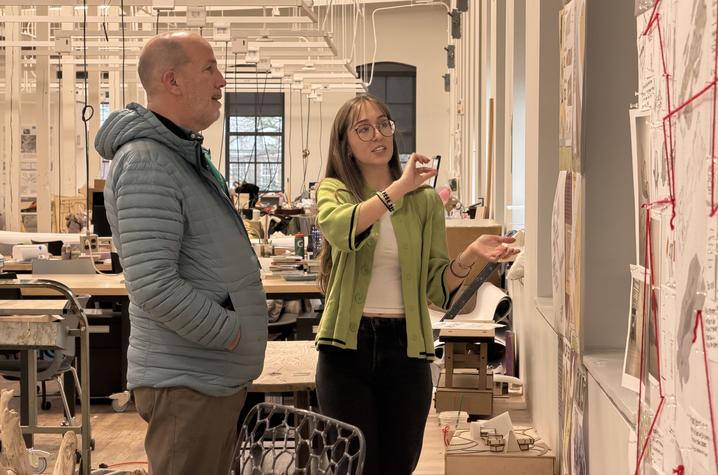
Lexington City Council Member Dave Sevigny reviews a student's project during final critiques.