
Lecture and Workshop Barry Wark: The Architecture of Ecology
Barry Wark explores architecture as a materially dynamic, ecocentric practice, conceiving buildings as assemblies of parts designed to weather, change, and be replaced over time. His projects use computational design and circular material strategies to foreground weathering as an active design force, allowing buildings to register their connection to the environment and create ambiguity between what is made and what emerges through climate and use. This lecture introduces recent work from his practice, showing how parts-based tectonics and ecocentric aesthetics can reshape contemporary environmental architecture.
Lecture: Friday, February 27 | 4:00 p.m. | David Biagi Forum (GDB 111)

Workshop: Weathering Artifacts
Saturday, February 28 | 9:00 a.m. - 6:00 p.m. (lunch provided)
Students will design spatial objects that intelligently respond to and accelerate weathering through computational intelligence and procedural design tools.
As we move into an age of environmental consciousness and the nature-architecture dichotomy dissolves in favor of emerging ideologies of interconnectedness, it may no longer be appropriate to perpetuate the notion that our buildings are impervious and separate from the environments in which they are sited. This has given rise to an emerging field of architectural design that experiments with new ecological aesthetics and a desire for architecture that expresses buildings' enmeshment with the environment. The workshop will explore these ideas through the design and representation of an object that speculates on conditions of permissible weathering, degradation, and inhabitation of our built environment by non-human entities. Through case studies, students will understand where and why these various effects occur in the built environment and how they might be controlled and augmented through design. The workshop will develop proposals using procedural modeling workflows in Houdini FX, allowing students to integrate computational intelligence through weather simulation and geometric analysis.
Students interested in the workshop can email Martin Summers to register.
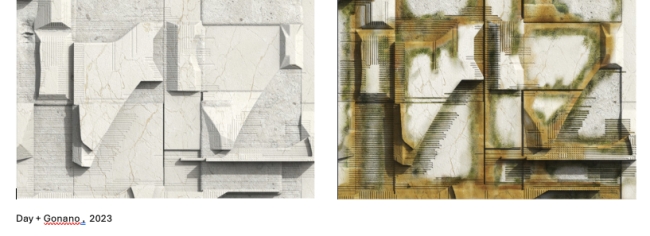
Barry Wark is an architect and designer known for work that attempts to redefine environmental architecture in the age of ecological awareness. Born in Scotland and now based in New York, his practice is shaped by an early familiarity with buildings as artifacts that age, stain, erode, and change—formed as much by climate and use as by design intent. His work treats architecture not as a fixed object, but as something continuously altered by its environment over time.
Across projects, his work is recognized for material and spatial qualities that resist clear distinctions between what is made and what emerges over time. Buildings, objects, and assemblies are designed to register climate, exposure, and use, promoting the display of processes such as weathering, accumulation, and decay. This approach produces architectures that situate aesthetics as central to the design of environmental architecture, supported by circular material strategies and computational intelligence.
Wark has taught and held academic appointments internationally, including at the University of Pennsylvania, the Bartlett School of Architecture, the Royal Melbourne Institute of Technology, Texas A&M University, Oxford Brookes University, and the Architectural Association Visiting School, and is a frequent invited lecturer and critic at schools of architecture worldwide. His work has been widely published in Frame, Dezeen, Vanity Fair, and STIR, and exhibited internationally, including at the Dubai Museum of the Future and the Venice Biennale.