
Opening September 18 After the Plan: An Exhibition by Clarissa Tossin
The College of Design Gallery invites you to attend the opening of After the Plan, an exhibition of two immersive, two-channel video works by Brazilian-born, Los Angeles-based artist Clarissa Tossin. Streamlined: Belterra, Amazônia / Alberta, Michigan connects two Ford company towns built in 1935 — one in the Brazilian Amazon and one in Michigan’s Upper Peninsula — through their shared histories of planned architecture, resource extraction, and industrial production. White Marble Everyday follows the workers who maintain the monumental architecture of Brasília’s Supreme Federal Court.
Presented in conjunction with Tossin’s concurrent exhibition When Two Places Look Alike at the University of Kentucky Art Museum, After the Plan considers what happens beyond the conception of architecture: the labor, materials, landscapes, systems, and people required to sustain a planned environment. Tossin will give a lecture on October 16 at the Singletary Center for the Arts as part of the R.C. May Photography Lecture Series.
Opening Reception: Friday, September 18 | 5-8 p.m.
The exhibition opening coincides with the LexArts Hop, with light refreshments served in the gallery.

Works featured in the exhibition
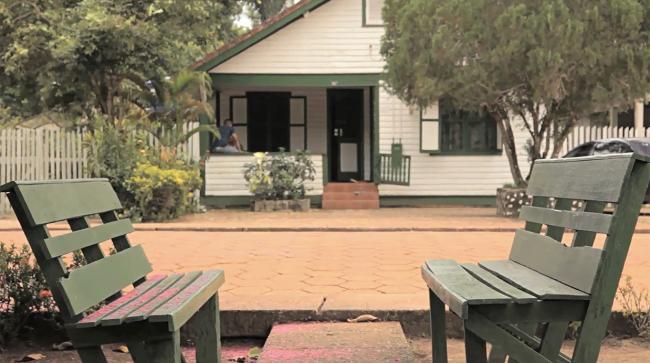
Streamlined: Belterra, Amazônia /Alberta, Michigan, 2013
Two-channel HD video projection (15:00 min. each)
This video installation compares and contrasts two Ford Motor Company towns: Belterra, a Brazilian rubber plantation village in the Amazon forest and Alberta, a sawmill town in Michigan’s Upper Peninsula. Built concurrently in 1935, each town provided, respectively, rubber and wood for the manufacturing of the Model T in the United States. The immersive environment establishes a sense of place, highlighting how specific cultural characteristics inhabited and changed these equivalent, pre-planned company towns.

Title: White Marble Everyday, 2009
Two-channel HD video, 05:42 (loop)
The white marble floors of the Brasilia’s Federal Supreme Court building, designed by the architect Oscar Niemeyer in 1957, are cleaned every day. This video explores this daily ritual, choreographing it as a wasteful process that maintains the monumentality of the structure and the utopian promise of the city’s plan.